
Every board meeting now includes a slide about AI. Every earnings call references transformation. Every strategy document promises responsible innovation. And yet, when the dust settles, most companies have deployed AI tools without a single person formally accountable for how those tools make decisions, handle data, or affect the people they touch.
That gap — between AI ambition and AI governance — is quietly becoming one of the most consequential talent problems in business today.
The Governance Crisis Nobody Is Talking About
We are in a strange moment. Generative AI adoption has outpaced every previous enterprise technology wave. According to McKinsey, more than 70% of organizations have deployed AI in at least one business function. And yet, a 2024 survey by the ISACA found that fewer than half of organizations have a formal AI governance framework in place — and an even smaller fraction have the dedicated human talent to run one.
Think about what that means in practice. Companies are using AI systems to screen job applicants, approve loans, flag medical anomalies, set insurance premiums, and personalize the content millions of people see every day — often with no one clearly responsible for auditing those outcomes, documenting those decisions, or course-correcting when something goes wrong.
This is not a hypothetical risk. It is an active liability. Regulatory frameworks — the EU AI Act, the NIST AI Risk Management Framework, emerging SEC guidance on AI disclosure — are moving from guidelines to enforcement. Companies that cannot demonstrate human oversight of their AI systems are going to find themselves exposed in ways their legal teams did not anticipate.
Why Companies Are Behind
The talent challenge here is structural, not incidental. Most organizations built their AI strategies around engineering capability: data scientists, ML engineers, LLM architects. Those hires were right. But they were incomplete.
Governance is a different discipline. It sits at the intersection of policy, ethics, legal compliance, risk management, and technical literacy. The people who do it well are rare, partly because the field itself is young, and partly because very few organizations have made it a clear career path.
Here is what that looks like on the ground:
The technical teams don't own it. Engineers are focused on building and shipping. Asking them to self-govern creates conflicts of interest and adds cognitive load to roles that are already stretched thin.
The legal and compliance teams aren't equipped for it. Traditional legal and risk functions understand contracts and regulations. They often lack the technical depth to evaluate model behavior, understand training data provenance, or assess the downstream effects of algorithmic bias.
The C-suite has delegated it to the wrong person. In many organizations, "AI governance" has landed on a Chief Privacy Officer, a CTO, or a recently promoted Director of AI Strategy — none of whom were hired to do this, and none of whom have the bandwidth to do it well.
The result is a governance vacuum dressed up in good intentions.
What the Right Talent Actually Looks Like
Effective AI governance is not a single role — it is a function, and building it requires intentional hiring across several dimensions.
AI Ethics and Policy Leads bring the frameworks. They understand regulatory landscapes, can translate policy into operational guidelines, and know how to build accountability structures that survive organizational change. These professionals often come from law, public policy, or academic research — and they need a technical co-pilot to be effective.
Responsible AI Engineers build the guardrails into the systems themselves. They specialize in bias auditing, model explainability, fairness metrics, and red-teaming. This is a technical discipline that goes beyond typical ML engineering and requires specific expertise in AI safety tooling.
AI Risk and Compliance Managers sit at the intersection of legal exposure and operational process. They are fluent in both regulatory language and system design. As AI regulations mature, these roles will become as important in financial services, healthcare, and insurance as traditional compliance officers.
AI Governance Program Managers run the infrastructure — the documentation, the review cycles, the cross-functional stakeholder processes. Think of them as the operators who keep the governance engine running after the strategy has been set.
None of these roles are easy to fill. The candidate pools are small, the title conventions are inconsistent, and the compensation expectations are being set in real time. Companies trying to hire reactively — after an incident, after a regulatory inquiry, after a board demand — find themselves competing for the same thin slice of talent with much longer lead times than they expected.
The Cost of Getting This Wrong
Before companies dismiss AI governance as a compliance overhead, consider the downside scenarios.
Regulatory penalties under frameworks like the EU AI Act can reach 3% to 6% of global annual revenue for high-risk AI violations. Class-action litigation around algorithmic discrimination is accelerating in the United States. Reputational exposure from publicized AI failures — biased hiring tools, hallucinating customer service bots, opaque automated decisions — can do damage that legal settlements cannot repair.
More quietly, there is an internal cost: the erosion of employee and customer trust. Workers who don't understand how AI is being used to evaluate their performance, or customers who don't know how automated systems are shaping their experience, are not passive observers. They notice. They disengage. They leave.
Governance is not a burden on innovation. Done well, it is the infrastructure that makes sustainable AI adoption possible.
The Hiring Window Is Now
Here is the uncomfortable reality: the supply of qualified AI governance professionals is not growing as fast as demand. Early movers are locking up the best candidates. Organizations waiting for the "right moment" — after the next product launch, after the budget cycle, after the new leadership team settles in — are not waiting for a better time. They are waiting until the talent they need is no longer available at the compensation levels they have in mind.
The companies that will navigate the next wave of AI regulation without crisis are the ones building governance capability now, before it becomes mandatory, before the talent market tightens further, and before a preventable failure forces the issue.
How 4 Staffing Corp Can Help
At 4 Staffing Corp, we specialize in exactly this kind of critical, high-stakes technical and emerging-technology hiring. We have spent more than two decades building the networks and the sourcing methodologies that surface candidates most recruiting teams never find.
We understand AI governance as a discipline — not just as a job category. That means we can help you define the roles you actually need, not just post the ones you think you need. We can help you build a governance team from the ground up, augment an existing function with contract specialists, or conduct a retained search for a senior leader who can own this at the executive level.
Our services include:
- Retained Search for senior AI governance, ethics, and risk leadership
- Staff Augmentation for contract-based responsible AI engineers and policy specialists
- RPO Services for organizations building governance functions at scale
- Agile Sprint Sourcing when you need to fill multiple governance roles quickly
If you are not sure where to start, that is exactly the conversation we are built for.
Let's Talk
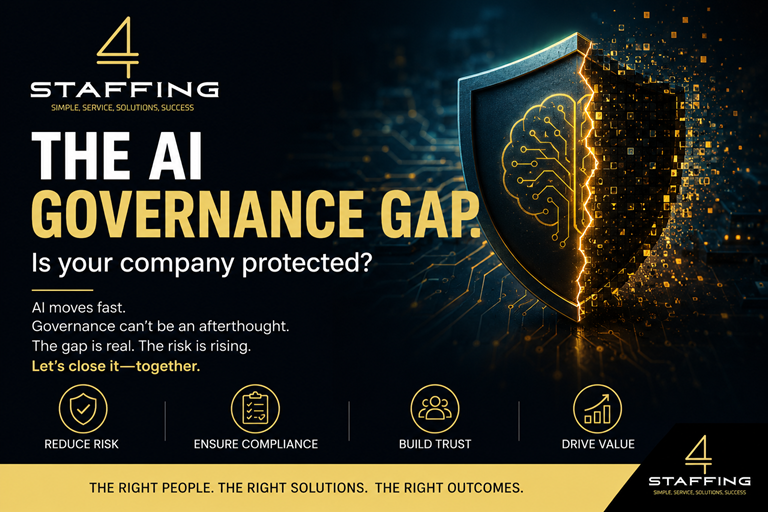
The governance gap is real. The regulatory pressure is real. And the talent market is moving faster than most hiring managers expect.
Schedule a consultation with our AI practice team today.
1-888-324-STAF (7823)
No hire, no fee. Nothing to lose.
4 Staffing Corp is a nationwide AI, Data & Tech recruiting firm partnering with companies that need to hire exceptional AI, data science, cloud, and emerging technology talent. We become your recruiting team.