
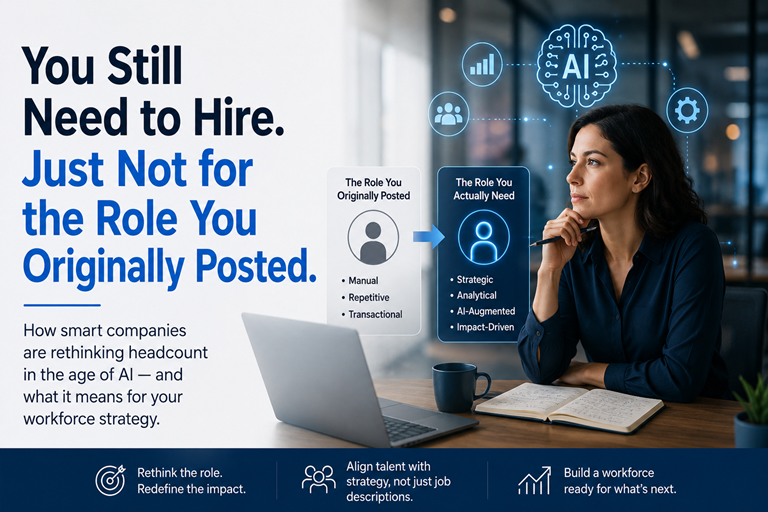
You Still Need to Hire. Just Not for the Role You Originally Posted.
How smart companies are rethinking headcount in the age of AI — and what it means for your workforce strategy.
The headlines are loud right now. Layoffs. AI. Efficiency. Fewer people doing more. And if you're a hiring manager or business leader, you're probably feeling the pressure from both sides: leadership pushing you to do more with less, while your team quietly burns out trying to keep up.
Here's what we're seeing on the ground — and what the data is starting to confirm.
Companies aren't done hiring. They're hiring wrong. AI Hiring Trends 2026
The "Do More With Less" Trap
Over the past 18 months, AI-attributed job cuts have accelerated dramatically. More than 100,000 employees were impacted by AI-driven layoffs in 2025 alone, with that number already exceeding 70,000 in the first months of 2026. The companies making these moves — Amazon, Block, Atlassian, Cloudflare, Pinterest — aren't struggling businesses. They're profitable organizations betting that AI can absorb the work that people used to do.
Some of them are right. Some of them will quietly rehire in 12 months when they realize they were wrong.
Forrester has already documented this pattern: 55% of employers who made AI-attributed cuts in 2025 reportedly regret the decision. Why? Because AI at its current stage of development requires more human oversight, more contextual judgment, and more institutional knowledge than the initial productivity claims accounted for. The human layer was cut before its role in the system was properly understood.
What this creates for the companies that didn't cut — or that are now rebuilding — is a workforce gap that looks very different from anything they've hired for before.
The Gap Nobody Saw Coming
Here's the real issue: when organizations eliminate roles and hand the remaining work to AI tools, they're making an assumption that often turns out to be wrong — that the people still on the team have the skills, bandwidth, and frankly the interest to become AI operators on top of everything else they're already doing.
That's not a reasonable ask.
A legacy employee who has spent years mastering their domain may not be the right person to also become fluent in AI workflows, prompt engineering, quality control, and output validation. It's not a reflection of their talent or value. It's simply a different skill set — one that requires a specific kind of mindset and, increasingly, specific training.
The companies that are winning right now aren't asking their best people to become AI experts by default. They're hiring for it.
What the Data Shows
The numbers are striking. While traditional tech roles are being cut at scale, AI-adjacent hiring is exploding in the opposite direction:
- AI Engineer postings grew 654% from the first half of 2024 to the second half of 2025
- Prompt engineering postings hit 121,000 in the second half of 2025 — a 777% increase
- AI governance roles grew 1,257% — a category that barely existed 18 months ago
- The share of AI/ML jobs in the tech market jumped from 10% to 50% between 2023 and 2025
- Workers with AI skills now earn 56% more than peers in comparable roles without them
The companies making cuts and the companies making hires are — in many cases — the same companies. They're not reducing headcount. They're reshaping it.
The New Roles Worth Understanding
You don't have to be a tech company to need these people. We're seeing demand emerge across industries — from financial services to healthcare to professional services. Here's a plain-English breakdown of the roles that are genuinely in demand:
AI-Human Workflow Specialists redesign how your existing teams work alongside AI. They don't just deploy tools — they figure out where AI helps, where it doesn't, and how to get actual adoption instead of expensive shelf-ware.
Prompt Engineers build the systematic frameworks that make AI tools produce consistent, reliable, on-brand output. Companies using structured prompt engineering report significantly fewer errors and better alignment between AI outputs and real business needs.
AI Enablement Leads run internal adoption programs — training employees, building playbooks, and tracking whether AI investments are actually producing results. Think of it as the bridge between the tool you bought and the ROI you were promised.
Decision Engineers map the workflows where humans and AI should work together — determining which decisions the model makes, where human review is required, and how to measure whether the whole system is actually working better.
Forward-Deployed AI Specialists are increasingly common in companies that sell AI-powered products or services. They bridge the gap between a general-purpose AI platform and what a specific client actually needs it to do.
What This Means for Hiring Managers Right Now
If you're being told you can't backfill a role — or that AI should cover the gap — here's the conversation worth having with your leadership team:
The question isn't whether you need a headcount. It's whether you need the same headcount you originally planned for.
A role that was once focused on manual execution might now be better filled by someone with strong AI fluency who can run that function at a higher level with better tools. That's not replacing the old role — it's evolving it. And it often takes someone new to bring that capability in, because you can't always ask your existing team to reinvent themselves in parallel with their current workload.
The organizations building competitive advantages right now are the ones that:
- Audit the gap honestly — where is work actually falling through the cracks?
- Separate "AI can do this" from "AI can do this without oversight" — they're very different things
- Hire for AI-adjacent skills rather than waiting for existing employees to reskill organically
- Treat AI enablement as a role, not an add-on to someone's existing job description
A Note to Candidates Reading This
If you're in the job market and feeling uncertain about where your skills fit in a world of AI disruption — this landscape is genuinely full of opportunity, but it requires intentionality.
The most in-demand people right now aren't just technically skilled. They're translators — professionals who can bridge the gap between what AI is capable of and what a business actually needs. Domain expertise combined with AI fluency is a combination most companies are struggling to find.
That's not a threat. That's leverage.
The Bottom Line
The companies that come out ahead in this moment won't be the ones that cut the deepest or deployed the most AI tools. They'll be the ones that figured out — faster than their competitors — exactly where humans add irreplaceable value, and hired specifically for that.
That's the conversation we're having with every client right now. And increasingly, it's leading to a hire — just not the one anyone originally had in mind.
If you're navigating workforce decisions in this environment and want a thought partner, we'd welcome the conversation. Reach out to our team — this is exactly what we're here for.