

Featured Articles
Featured Articles
Somewhere in your CRM right now there's a contract up for
renewal in 90 days.
There's a customer who hasn't logged in for 47 days.
There's an expansion opportunity sitting in a health score
report that nobody has reviewed this week.
And the person who should be managing all of it?
You haven't hired them yet.
THE ROLE THAT HOLDS YOUR REVENUE TOGETHER
Customer Success is no longer a support function. It is a
revenue function — and the market has caught up to that reality.
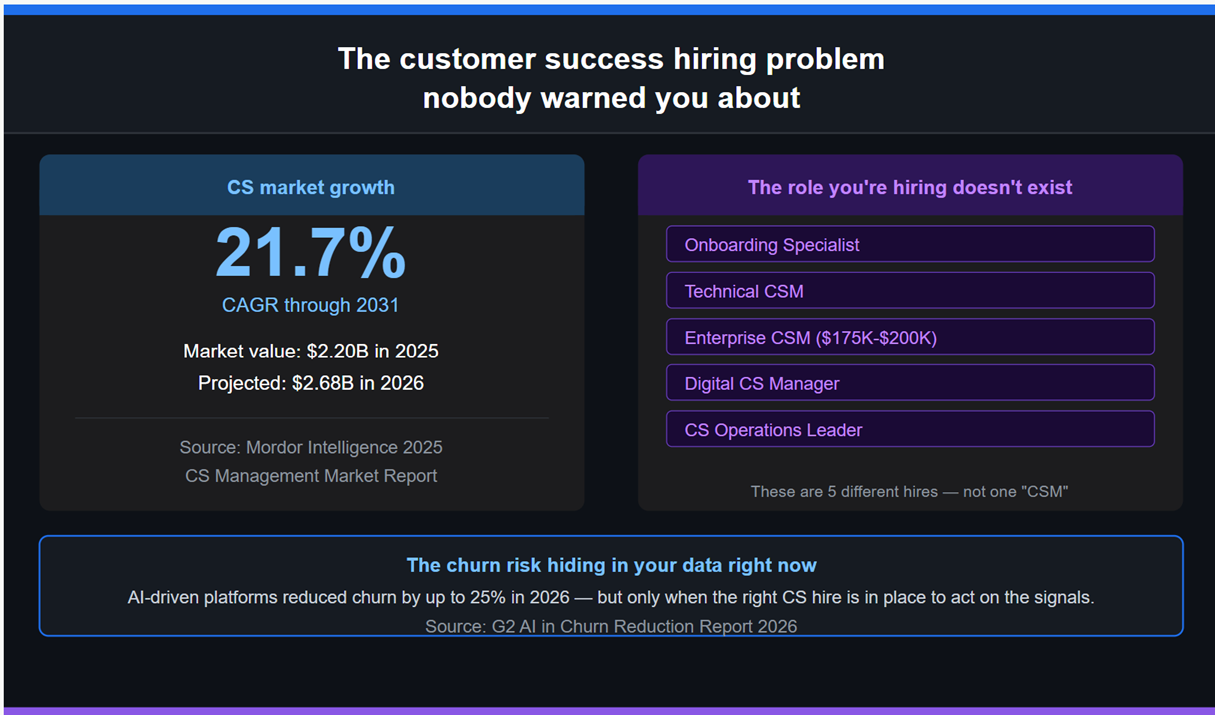
The global Customer Success Management market was valued at
$2.20 billion in 2025 and is forecast to reach $2.68 billion
in 2026, growing at a 21.7% compound annual rate through 2031.
That's not a mature market. That's a market still figuring
out what it needs.
According to Gartner's October 2025 forecast, worldwide IT
spending is projected to exceed $6 trillion in 2026 — a 9.8%
increase. With every dollar of software spend comes a renewal
decision, an expansion conversation, and a churn risk that
needs to be managed.
Companies that don't have the right CS talent in place to
protect that revenue are quietly bleeding it.
THE PARADOX OF CUSTOMER SUCCESS HIRING
Here's the problem that keeps showing up in conversations
with our clients:
The job description is wrong before they even post it.
Customer Success has splintered into half a dozen distinct
roles over the last three years. Lumping them all into a
single "CSM" job posting is the first mistake.
The role you actually need might be:
— An Onboarding Specialist who can compress time-to-value
for new customers
— A Technical CSM who can speak the language of your
product's API documentation
— An Enterprise CSM who manages eight-figure accounts and
runs executive business reviews
— A Digital CS Manager who builds scaled programs for
long-tail customers using automation
— A Customer Success Operations leader who builds the
infrastructure the whole team runs on
— A VP of Customer Success who can connect CS metrics
directly to board-level revenue conversations
Each of these is a different hire. Each requires a different
background, different skills and a different compensation model.
Enterprise CSMs at leading SaaS companies are commanding
$175,000 to $200,000 in total compensation in 2025.
That's not a support role salary. That's a revenue role salary —
because that's what they protect.
WHAT THE BEST CUSTOMER SUCCESS CANDIDATES ACTUALLY LOOK LIKE
After placing CS talent across dozens of growing tech companies
we've learned to look past the standard screen.
Certifications matter less than outcomes.
The best CSMs can tell you exactly how much revenue they
protected in their last role. They know their Net Revenue
Retention number. They know their churn rate. They know
which customer they saved from cancellation and how.
If a CS candidate can't speak in retention metrics
during an interview they're probably not a revenue-level
operator yet.
Domain knowledge is increasingly non-negotiable.
A CSM who has spent five years in SaaS analytics is
genuinely different from one who spent five years in
healthcare IT. Your customers notice. Enterprise clients
in particular expect their CSM to understand their
industry — not just your product.
The consultant-CSM is the new gold standard.
According to Betts Recruiting's 2025 compensation research,
many SaaS companies are actively seeking CS candidates with
strategy consulting backgrounds — McKinsey, Bain, Deloitte —
because the role now requires the same analytical rigor and
executive communication skills.
That talent doesn't come cheap and it doesn't respond
to cold InMails from companies they've never heard of.
THE AI COMPLICATION
Customer Success is being reshaped by AI faster than almost
any other function.
AI-driven churn management platforms reported churn reductions
of up to 25% in 2026 when predictive signals were embedded
directly into customer success workflows.
This sounds like good news for CS teams. In some ways it is.
But it raises a new hiring bar: the CSM of 2026 needs to
know how to work with AI tools, interpret predictive health
scores, build automated playbooks and still show up as a
trusted human advisor when the contract is on the line.
That combination — technical fluency plus human relationship
management plus commercial instincts — is genuinely rare.
And the companies that find it first are the ones protecting
their NRR while everyone else watches their renewal rate slide.
WHERE 4 STAFFING CORP COMES IN
We've spent 20 years placing go-to-market talent at
growing technology companies — including Customer Success
leaders, Enterprise CSMs, Onboarding Specialists and
CS Operations professionals.
We know the difference between a CSM who will hit the
ground running and one who will need 6 months to find
their footing.
And we know where the best ones are — most of them
aren't looking.
If your CS headcount is behind where it needs to be
heading into renewal season — or if you're building
the function from scratch — this is exactly the
conversation we have every day.
No hire. No fee. Nothing to lose.
→ Free consultation:
4staffing.net/index.php/contact
→ Learn more about our Sales and Go-to-Market recruiting:
4staffing.net/index.php/our-specialties/85-sales-leadership-recruiting
Sources:
— Mordor Intelligence Customer Success Management
Market Report 2025-2031
— Gartner IT Spending Forecast October 2025
— Betts Recruiting Customer Success Compensation
Trends 2025
— Custify Customer Success Statistics 2026
— G2 AI in Churn Reduction Report 2026
You've heard the stories about AI engineers being impossible to find.
Data scientists commanding $166K before they've unpacked their laptops.
Cloud architects fielding five offers before updating their LinkedIn.
Hardware engineering is harder. And nobody's talking about it.
While the tech recruiting world obsesses over software roles,
a quiet crisis is building on the hardware side — and growing
companies with product roadmaps that depend on it are starting
to feel the pain.
HERE'S WHAT THE DATA SAYS
According to the US Bureau of Labor Statistics, engineering
occupations are projected to grow 13% by 2031. That sounds
manageable until you add the other side of the equation.
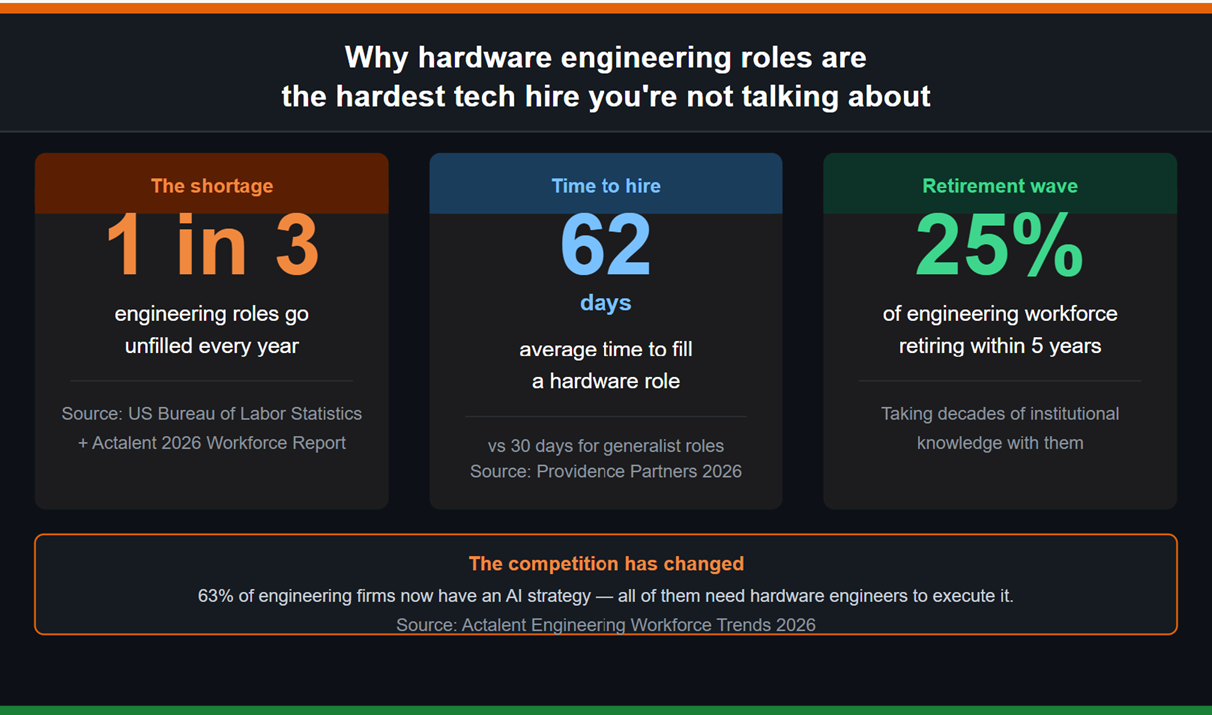
One in three engineering roles goes unfilled every year.
The average engineering hire takes 58 to 62 days — and that's
for companies that know what they're looking for. Many don't.
And here's the structural problem that doesn't get enough
attention: approximately 25% of the current engineering
workforce plans to retire within the next five years.
These aren't just headcount vacancies. When a 30-year
veteran hardware engineer walks out the door, they take
decades of institutional knowledge with them. PCB layout
instincts. Signal integrity intuitions. Systems integration
experience that cannot be taught in a classroom.
You cannot replace that overnight.
WHAT MAKES HARDWARE DIFFERENT FROM SOFTWARE
Software engineering has a global talent pool. If you can't
find a Python developer in New York you can find one in
Austin, London or remotely anywhere in the world.
Hardware doesn't work that way.
Roles requiring physical lab access, prototype iteration,
manufacturing floor presence or security clearance are
location-bound. You can't design a PCB from a coffee shop.
You can't validate an RF circuit over Zoom.
This geographic constraint narrows the available talent
pool dramatically — especially for companies outside
the major tech hubs.
The most in-demand hardware specializations right now:
— PCB designers and layout engineers
— Embedded systems engineers
— Electrical engineers with RF or power experience
— FPGA developers
— Hardware security specialists
— Systems integration engineers
— Semiconductor and chip design engineers
Each of these is a niche within a niche. And the candidates
who have deep experience in them are not sitting on job boards
refreshing their inboxes.
THE AI EFFECT ON HARDWARE HIRING
Here's a wrinkle that most hiring managers don't see coming.
The AI buildout is a hardware problem as much as a software one.
Every large language model needs chips to run on. Every data
center needs power infrastructure. Every AI-enabled product
needs sensors, processors and embedded systems.
According to Actalent's 2026 engineering workforce research,
63% of engineering firms are already building or have an
AI strategy in place — and they all need hardware engineers
to execute it.
This means hardware engineering talent is now competing
for the same budget as AI software talent. The companies
writing the biggest checks for engineering talent are no
longer just the defense primes and chip manufacturers.
They're the hyperscalers, the AI hardware startups and
the EV manufacturers.
The talent pool didn't get bigger. The competition for it did.
WHAT ACTUALLY WORKS WHEN HIRING HARDWARE ENGINEERS
After two decades of placing technical talent at growth-stage
companies, here's what we see working right now:
Stop writing job descriptions that describe a unicorn.
A job posting asking for PCB layout experience, FPGA development,
embedded C expertise AND systems architecture ownership is
describing four different people. Get specific about the
single hardest problem you need solved.
Move faster than your process allows.
The best hardware candidates receive multiple offers within
weeks. If your interview process takes eight rounds over
six weeks you will lose every candidate worth having.
Addison Group's 2026 engineering workforce data confirms
there are currently three engineering jobs for every one
qualified candidate. They are choosing who to talk to —
not the other way around.
Look beyond the resume.
Hardware engineers build things. The best ones have
GitHub repos, personal projects, conference presentations
or patents. A portfolio tells you more than a degree.
Be honest about location.
If the role requires on-site presence say so clearly and
early. Candidates who discover this surprise late in the
process will exit — and you'll have wasted weeks of
recruiting cycles.
WHERE 4 STAFFING CORP COMES IN
We've been placing hardware and electrical engineering
talent at growing technology companies for 20 years.
We know where the PCB designers are.
We know which embedded engineers are quietly open to a move.
And we know how to have the conversation that gets a
passive candidate to take your call.
If you have a hardware engineering role that's been open
for more than 60 days — or if you know one is coming
and want to get ahead of it — let's talk before the
timeline becomes urgent.
No hire. No fee. Nothing to lose.
→ Free consultation:
4staffing.net/index.php/contact
Sources:
— US Bureau of Labor Statistics Occupational Outlook 2024
— Addison Group 2026 Engineering Hiring Trends Report
— Actalent Engineering Workforce Trends 2026
— Providence Partners Engineering Talent Shortage 2026
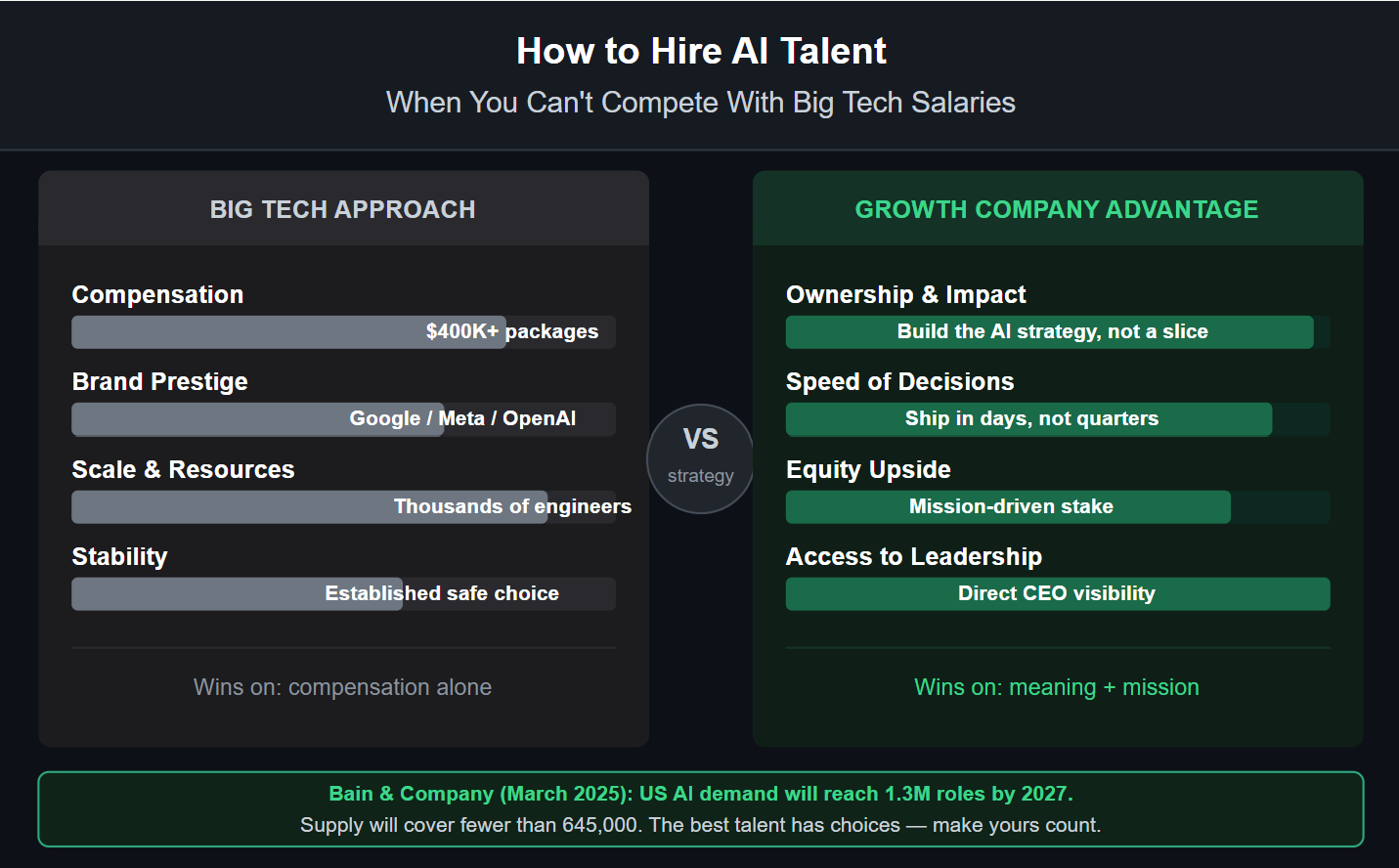
OpenAI, Google, Microsoft and Meta are
paying AI engineers $300,000 to $500,000+
in total compensation.
You are not.
So how do growing tech companies between
50 and 500 employees actually compete for
AI, machine learning and data science talent
without a Big Tech budget?
After 20 years of placing technical talent
at growth-stage companies, here's what
actually works.
STOP COMPETING ON SALARY. COMPETE ON IMPACT.
The AI engineers who leave Google for a
150-person company aren't leaving for more
money. They're leaving because they want
to be the person who builds the AI strategy
— not the 47th engineer on a team working
on one small slice of a massive product.
According to Bain & Company's March 2025
research, US demand for AI talent will hit
1.3 million roles by 2027 against a supply
of fewer than 645,000 qualified professionals.
In that environment, the best AI talent has
choices. They're choosing based on:
— Scope of ownership and influence
— Speed of decision-making
— Access to leadership
— Mission and product clarity
— Equity upside
Your job description should lead with these —
not the tech stack.
WRITE A JOB DESCRIPTION THAT DESCRIBES
A PROBLEM, NOT A WISH LIST
The most common hiring mistake we see at
growth companies is the kitchen-sink job
description.
10+ years ML experience. Production MLOps.
LLM expertise. Data strategy ownership.
Team leadership. PhD preferred.
That's four or five different roles.
No single person is all of those things
at the level you're describing.
The companies landing AI talent today
are writing descriptions that say:
"We have 18 months of customer data
sitting in Snowflake that nobody has
built a model on yet. We need someone
to own that problem end-to-end."
That's a job description. The other thing
is a fantasy.
LOOK IN THE RIGHT PLACES
The AI and data science professionals who
fit a 50-500 person growth company are
rarely the ones actively searching job
boards. They're working on interesting
problems and will only surface for
opportunities that find them directly.
Where are they?
— Publishing on GitHub and Hugging Face
— Speaking at local ML meetups
— Contributing to open source projects
— In the alumni networks of specific
university programs
— Known to specialized recruiters who
have been in the AI space for years
At 4 Staffing Corp we've been placing
AI, ML and data science professionals
at growth-stage tech companies for
two decades. We know where the talent
is and — more importantly — we know
how to have the conversation that gets
a highly-employed engineer to take
your call.
If you're a growing tech company trying
to build an AI function without a
Big Tech budget — this is exactly the
conversation we have every day.
→ Free consultation, no obligation:
4staffing.net/index.php/our-specialties/81-ai-machine-learning-recruiting
Sources:
— Bain & Company: Widening Talent Gap
Threatens Executives' AI Ambitions
(March 2025)
— US Bureau of Labor Statistics 2025
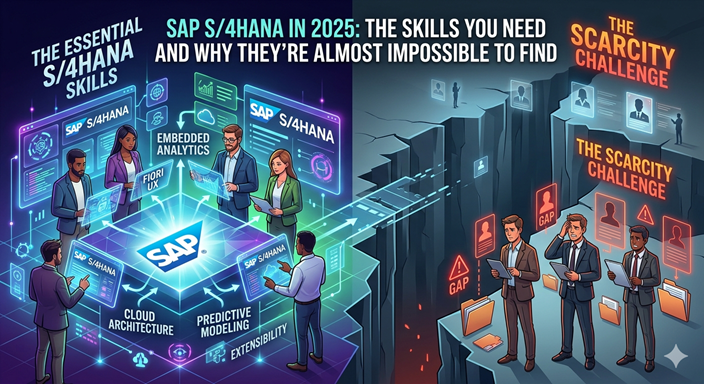
SAP set a hard deadline.
All customers must migrate from SAP ECC
to SAP S/4HANA by 2027. That's roughly
40,000 companies worldwide facing one of
the most complex technology migrations
in enterprise history — at the same time.
The talent market for SAP S/4HANA
professionals has never been more
competitive. And for growing companies
without a dedicated SAP practice,
finding the right person feels almost
impossible.
Here's what you need to know.
WHY S/4HANA IS A FUNDAMENTALLY
DIFFERENT HIRING CHALLENGE
S/4HANA isn't an upgrade of SAP ECC.
It's a complete reimagination of the
platform built on the HANA in-memory
database with a simplified data model,
Fiori user experience and embedded
AI capabilities.
This means professionals with deep
SAP ECC experience aren't automatically
qualified for S/4HANA implementations.
The skills required are different — and
the number of people who have actually
delivered a successful S/4HANA go-live
is still relatively small.
The most in-demand SAP S/4HANA skills
include:
— S/4HANA Finance (Central Finance,
Group Reporting)
— SAP Basis for HANA administration
— SAP BTP (Business Technology Platform)
for integration and extension
— SAP Rise migration expertise
— Industry-specific S/4HANA configurations
(Manufacturing, Retail, Professional
Services)
— SAP Activate methodology experience
THE 2027 DEADLINE IS CREATING A TALENT CRUNCH
With tens of thousands of companies all
needing to migrate by the same deadline,
demand for experienced S/4HANA talent
has surged. The consultants and architects
who have delivered multiple successful
S/4HANA implementations are being
pulled into large system integrator
engagements — leaving mid-market
companies competing for the remaining
talent.
For companies between 10 and 1,000
employees, this creates a specific
problem: the SAP talent you need is
being absorbed by Fortune 500 projects
at rates your budget may not match.
WHAT ACTUALLY WORKS
After 20 years placing SAP professionals
we've watched every market cycle. Here's
what the companies successfully building
their SAP teams in 2026 are doing
differently:
They're hiring for the specific phase
of their project. A design-phase
engagement requires different skills
than a go-live support role. Clarity
on where you are in the project
dramatically narrows the search.
They're open to contract-to-hire. Many
of the best S/4HANA consultants work
independently. A contract engagement
gets you their expertise immediately
while you evaluate fit.
They're not waiting for the perfect
resume. The best S/4HANA professionals
don't have polished LinkedIn profiles.
They're too busy on projects. You need
a recruiter with direct relationships —
not someone running LinkedIn searches.
At 4 Staffing Corp we have two decades
of SAP relationships across every module
and every industry. If you're planning
an S/4HANA migration and need to build
your team — start the conversation now,
before the 2027 crunch makes it even
harder.
→ 4staffing.net/index.php/our-specialties/84-erp-crm-talent-solutions
Source: SAP End of Maintenance
Announcement / SAP Roadmap 2025
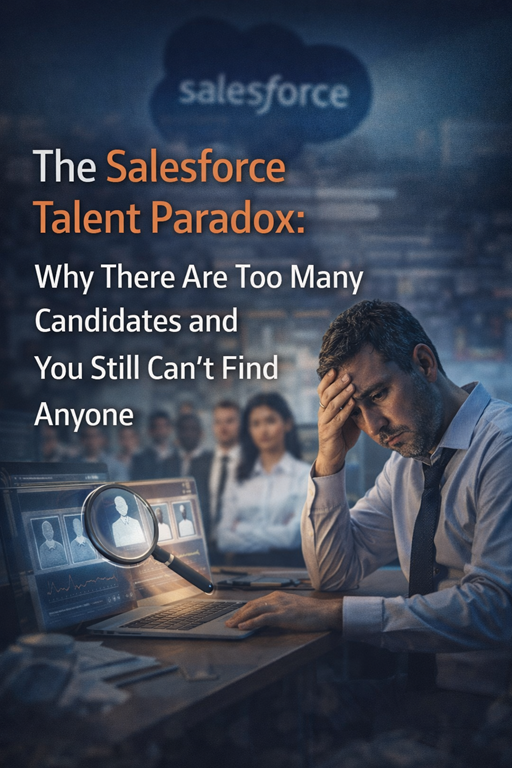
If you've tried to hire a Salesforce professional
in the last 12 months you've probably experienced
something strange:
Hundreds of applicants for every job posting.
And none of them quite right.
This isn't bad luck. It's the Salesforce Talent
Paradox — and understanding it is the key to
hiring the right person.
THE NUMBERS BEHIND THE PARADOX
According to the 10K Salesforce Ecosystem Report
2025, the global supply of Salesforce professionals
now exceeds demand by 3.4 times overall.
The market is flooded — at the generalist level.
Admins. Basic developers. Entry-level consultants.
There are more of them than there are jobs.
Bootcamps and Trailhead have trained an entire
generation of Salesforce professionals, many of
whom have certifications but limited real-world
implementation experience.
But here's where the paradox kicks in:
The Technical Architect role — the person who
can design complex enterprise implementations,
lead multi-cloud projects and integrate Salesforce
with the rest of your tech stack — saw demand
grow 27% in 2025.
Supply for that same role grew just 4%.
Technical Architects make up only 1% of the
global Salesforce talent pool.
So while the market is saturated with generalists,
the specialists your business actually needs are
rarer than ever.
THE AGENTFORCE EFFECT
Salesforce's launch of Agentforce — its AI
automation platform built directly into the
CRM — has created an entirely new skills gap
almost overnight.
Salesforce itself acknowledged this and made
AI Specialist certifications free through 2025
to accelerate adoption. Even so, professionals
who can actually design and implement
Agentforce solutions — not just talk about
them — are extraordinarily scarce.
"People who can actually design and implement
AI solutions, not just talk about them — that's
where the demand is."
— Evaldas, Salesforce ecosystem expert,
Salesforce Ben 2026 Market Outlook
WHAT THIS MEANS FOR YOUR HIRING STRATEGY
If you're hiring Salesforce talent in 2025
the single most important thing you can do
is get specific about the problem you need
solved — not the platform features you
want someone to know.
The companies filling senior Salesforce roles
quickly are not posting on job boards. They're
working with recruiters who have direct
relationships with the 1% of the market
that can actually deliver what they need.
At 4 Staffing Corp we've spent 20 years
mapping the senior end of the Salesforce
ecosystem. We know who the Technical
Architects are. We know who's open to a
conversation and who isn't. And we know
what it takes to get them interested in
your opportunity.
If you're experiencing the paradox — flooded
with resumes that don't fit — let's talk
about a different approach.
→ 4staffing.net/index.php/our-specialties/84-erp-crm-talent-solutions
Sources:
— 10K Salesforce Ecosystem Report 2025
(via Salesforce Ben)
— Salesforce Ben Must Know Job Trends 2026
— Focus on Force: Salesforce Careers
Outlook Q4 2025






4 Staffing Corp., Copyright © 2005-Present. All Rights Reserved. Privacy Policy