

DEI FIRST
DEI FIRST
Every board meeting now includes a slide about AI. Every earnings call references transformation. Every strategy document promises responsible innovation. And yet, when the dust settles, most companies have deployed AI tools without a single person formally accountable for how those tools make decisions, handle data, or affect the people they touch.
That gap — between AI ambition and AI governance — is quietly becoming one of the most consequential talent problems in business today.
The Governance Crisis Nobody Is Talking About
We are in a strange moment. Generative AI adoption has outpaced every previous enterprise technology wave. According to McKinsey, more than 70% of organizations have deployed AI in at least one business function. And yet, a 2024 survey by the ISACA found that fewer than half of organizations have a formal AI governance framework in place — and an even smaller fraction have the dedicated human talent to run one.
Think about what that means in practice. Companies are using AI systems to screen job applicants, approve loans, flag medical anomalies, set insurance premiums, and personalize the content millions of people see every day — often with no one clearly responsible for auditing those outcomes, documenting those decisions, or course-correcting when something goes wrong.
This is not a hypothetical risk. It is an active liability. Regulatory frameworks — the EU AI Act, the NIST AI Risk Management Framework, emerging SEC guidance on AI disclosure — are moving from guidelines to enforcement. Companies that cannot demonstrate human oversight of their AI systems are going to find themselves exposed in ways their legal teams did not anticipate.
Why Companies Are Behind
The talent challenge here is structural, not incidental. Most organizations built their AI strategies around engineering capability: data scientists, ML engineers, LLM architects. Those hires were right. But they were incomplete.
Governance is a different discipline. It sits at the intersection of policy, ethics, legal compliance, risk management, and technical literacy. The people who do it well are rare, partly because the field itself is young, and partly because very few organizations have made it a clear career path.
Here is what that looks like on the ground:
The technical teams don't own it. Engineers are focused on building and shipping. Asking them to self-govern creates conflicts of interest and adds cognitive load to roles that are already stretched thin.
The legal and compliance teams aren't equipped for it. Traditional legal and risk functions understand contracts and regulations. They often lack the technical depth to evaluate model behavior, understand training data provenance, or assess the downstream effects of algorithmic bias.
The C-suite has delegated it to the wrong person. In many organizations, "AI governance" has landed on a Chief Privacy Officer, a CTO, or a recently promoted Director of AI Strategy — none of whom were hired to do this, and none of whom have the bandwidth to do it well.
The result is a governance vacuum dressed up in good intentions.
What the Right Talent Actually Looks Like
Effective AI governance is not a single role — it is a function, and building it requires intentional hiring across several dimensions.
AI Ethics and Policy Leads bring the frameworks. They understand regulatory landscapes, can translate policy into operational guidelines, and know how to build accountability structures that survive organizational change. These professionals often come from law, public policy, or academic research — and they need a technical co-pilot to be effective.
Responsible AI Engineers build the guardrails into the systems themselves. They specialize in bias auditing, model explainability, fairness metrics, and red-teaming. This is a technical discipline that goes beyond typical ML engineering and requires specific expertise in AI safety tooling.
AI Risk and Compliance Managers sit at the intersection of legal exposure and operational process. They are fluent in both regulatory language and system design. As AI regulations mature, these roles will become as important in financial services, healthcare, and insurance as traditional compliance officers.
AI Governance Program Managers run the infrastructure — the documentation, the review cycles, the cross-functional stakeholder processes. Think of them as the operators who keep the governance engine running after the strategy has been set.
None of these roles are easy to fill. The candidate pools are small, the title conventions are inconsistent, and the compensation expectations are being set in real time. Companies trying to hire reactively — after an incident, after a regulatory inquiry, after a board demand — find themselves competing for the same thin slice of talent with much longer lead times than they expected.
The Cost of Getting This Wrong
Before companies dismiss AI governance as a compliance overhead, consider the downside scenarios.
Regulatory penalties under frameworks like the EU AI Act can reach 3% to 6% of global annual revenue for high-risk AI violations. Class-action litigation around algorithmic discrimination is accelerating in the United States. Reputational exposure from publicized AI failures — biased hiring tools, hallucinating customer service bots, opaque automated decisions — can do damage that legal settlements cannot repair.
More quietly, there is an internal cost: the erosion of employee and customer trust. Workers who don't understand how AI is being used to evaluate their performance, or customers who don't know how automated systems are shaping their experience, are not passive observers. They notice. They disengage. They leave.
Governance is not a burden on innovation. Done well, it is the infrastructure that makes sustainable AI adoption possible.
The Hiring Window Is Now
Here is the uncomfortable reality: the supply of qualified AI governance professionals is not growing as fast as demand. Early movers are locking up the best candidates. Organizations waiting for the "right moment" — after the next product launch, after the budget cycle, after the new leadership team settles in — are not waiting for a better time. They are waiting until the talent they need is no longer available at the compensation levels they have in mind.
The companies that will navigate the next wave of AI regulation without crisis are the ones building governance capability now, before it becomes mandatory, before the talent market tightens further, and before a preventable failure forces the issue.
How 4 Staffing Corp Can Help
At 4 Staffing Corp, we specialize in exactly this kind of critical, high-stakes technical and emerging-technology hiring. We have spent more than two decades building the networks and the sourcing methodologies that surface candidates most recruiting teams never find.
We understand AI governance as a discipline — not just as a job category. That means we can help you define the roles you actually need, not just post the ones you think you need. We can help you build a governance team from the ground up, augment an existing function with contract specialists, or conduct a retained search for a senior leader who can own this at the executive level.
Our services include:
- Retained Search for senior AI governance, ethics, and risk leadership
- Staff Augmentation for contract-based responsible AI engineers and policy specialists
- RPO Services for organizations building governance functions at scale
- Agile Sprint Sourcing when you need to fill multiple governance roles quickly
If you are not sure where to start, that is exactly the conversation we are built for.
Let's Talk
The governance gap is real. The regulatory pressure is real. And the talent market is moving faster than most hiring managers expect.
Schedule a consultation with our AI practice team today.
1-888-324-STAF (7823)
No hire, no fee. Nothing to lose.
4 Staffing Corp is a nationwide AI, Data & Tech recruiting firm partnering with companies that need to hire exceptional AI, data science, cloud, and emerging technology talent. We become your recruiting team.
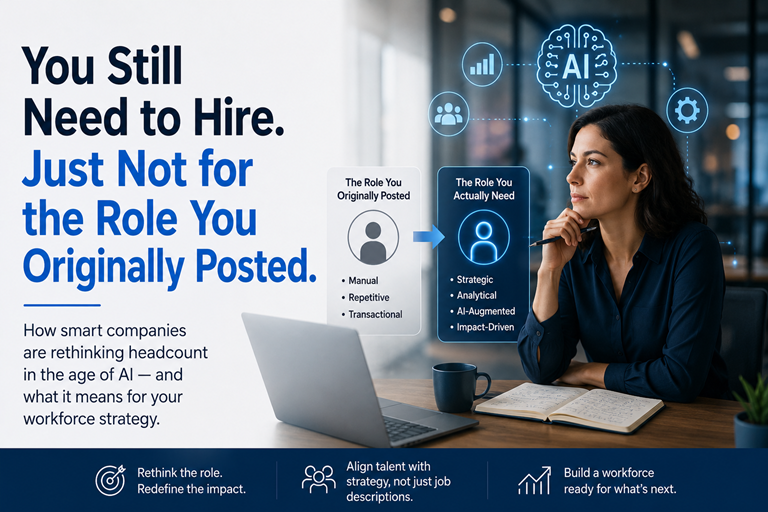
You Still Need to Hire. Just Not for the Role You Originally Posted.
How smart companies are rethinking headcount in the age of AI — and what it means for your workforce strategy.
The headlines are loud right now. Layoffs. AI. Efficiency. Fewer people doing more. And if you're a hiring manager or business leader, you're probably feeling the pressure from both sides: leadership pushing you to do more with less, while your team quietly burns out trying to keep up.
Here's what we're seeing on the ground — and what the data is starting to confirm.
Companies aren't done hiring. They're hiring wrong. AI Hiring Trends 2026
The "Do More With Less" Trap
Over the past 18 months, AI-attributed job cuts have accelerated dramatically. More than 100,000 employees were impacted by AI-driven layoffs in 2025 alone, with that number already exceeding 70,000 in the first months of 2026. The companies making these moves — Amazon, Block, Atlassian, Cloudflare, Pinterest — aren't struggling businesses. They're profitable organizations betting that AI can absorb the work that people used to do.
Some of them are right. Some of them will quietly rehire in 12 months when they realize they were wrong.
Forrester has already documented this pattern: 55% of employers who made AI-attributed cuts in 2025 reportedly regret the decision. Why? Because AI at its current stage of development requires more human oversight, more contextual judgment, and more institutional knowledge than the initial productivity claims accounted for. The human layer was cut before its role in the system was properly understood.
What this creates for the companies that didn't cut — or that are now rebuilding — is a workforce gap that looks very different from anything they've hired for before.
The Gap Nobody Saw Coming
Here's the real issue: when organizations eliminate roles and hand the remaining work to AI tools, they're making an assumption that often turns out to be wrong — that the people still on the team have the skills, bandwidth, and frankly the interest to become AI operators on top of everything else they're already doing.
That's not a reasonable ask.
A legacy employee who has spent years mastering their domain may not be the right person to also become fluent in AI workflows, prompt engineering, quality control, and output validation. It's not a reflection of their talent or value. It's simply a different skill set — one that requires a specific kind of mindset and, increasingly, specific training.
The companies that are winning right now aren't asking their best people to become AI experts by default. They're hiring for it.
What the Data Shows
The numbers are striking. While traditional tech roles are being cut at scale, AI-adjacent hiring is exploding in the opposite direction:
- AI Engineer postings grew 654% from the first half of 2024 to the second half of 2025
- Prompt engineering postings hit 121,000 in the second half of 2025 — a 777% increase
- AI governance roles grew 1,257% — a category that barely existed 18 months ago
- The share of AI/ML jobs in the tech market jumped from 10% to 50% between 2023 and 2025
- Workers with AI skills now earn 56% more than peers in comparable roles without them
The companies making cuts and the companies making hires are — in many cases — the same companies. They're not reducing headcount. They're reshaping it.
The New Roles Worth Understanding
You don't have to be a tech company to need these people. We're seeing demand emerge across industries — from financial services to healthcare to professional services. Here's a plain-English breakdown of the roles that are genuinely in demand:
AI-Human Workflow Specialists redesign how your existing teams work alongside AI. They don't just deploy tools — they figure out where AI helps, where it doesn't, and how to get actual adoption instead of expensive shelf-ware.
Prompt Engineers build the systematic frameworks that make AI tools produce consistent, reliable, on-brand output. Companies using structured prompt engineering report significantly fewer errors and better alignment between AI outputs and real business needs.
AI Enablement Leads run internal adoption programs — training employees, building playbooks, and tracking whether AI investments are actually producing results. Think of it as the bridge between the tool you bought and the ROI you were promised.
Decision Engineers map the workflows where humans and AI should work together — determining which decisions the model makes, where human review is required, and how to measure whether the whole system is actually working better.
Forward-Deployed AI Specialists are increasingly common in companies that sell AI-powered products or services. They bridge the gap between a general-purpose AI platform and what a specific client actually needs it to do.
What This Means for Hiring Managers Right Now
If you're being told you can't backfill a role — or that AI should cover the gap — here's the conversation worth having with your leadership team:
The question isn't whether you need a headcount. It's whether you need the same headcount you originally planned for.
A role that was once focused on manual execution might now be better filled by someone with strong AI fluency who can run that function at a higher level with better tools. That's not replacing the old role — it's evolving it. And it often takes someone new to bring that capability in, because you can't always ask your existing team to reinvent themselves in parallel with their current workload.
The organizations building competitive advantages right now are the ones that:
- Audit the gap honestly — where is work actually falling through the cracks?
- Separate "AI can do this" from "AI can do this without oversight" — they're very different things
- Hire for AI-adjacent skills rather than waiting for existing employees to reskill organically
- Treat AI enablement as a role, not an add-on to someone's existing job description
A Note to Candidates Reading This
If you're in the job market and feeling uncertain about where your skills fit in a world of AI disruption — this landscape is genuinely full of opportunity, but it requires intentionality.
The most in-demand people right now aren't just technically skilled. They're translators — professionals who can bridge the gap between what AI is capable of and what a business actually needs. Domain expertise combined with AI fluency is a combination most companies are struggling to find.
That's not a threat. That's leverage.
The Bottom Line
The companies that come out ahead in this moment won't be the ones that cut the deepest or deployed the most AI tools. They'll be the ones that figured out — faster than their competitors — exactly where humans add irreplaceable value, and hired specifically for that.
That's the conversation we're having with every client right now. And increasingly, it's leading to a hire — just not the one anyone originally had in mind.
If you're navigating workforce decisions in this environment and want a thought partner, we'd welcome the conversation. Reach out to our team — this is exactly what we're here for.
Your company has decided to get serious about AI.
You have use cases identified. You have budget. You
have executive buy-in. Now someone says you need
to hire a PM to lead it.
So you post a job for an "AI Program Manager" and
start getting resumes from "AI Project Managers."
Or the other way around.
Here is the thing — they are not the same role. And
hiring the wrong one is an expensive mistake that
will haunt your AI initiative for the next 18 months.
THE DIFFERENCE IS SCOPE NOT SENIORITY
Most people assume the difference between a program
manager and a project manager is just a title level —
that one is more senior than the other. That is only
partially true.
The real difference is scope of responsibility.
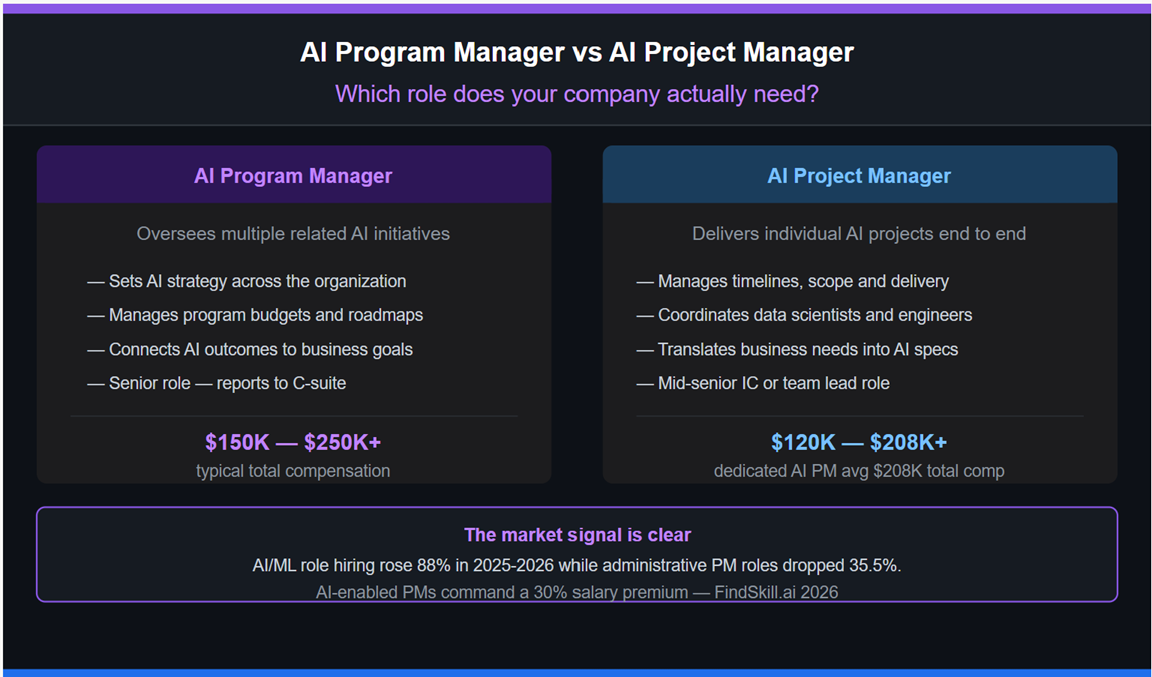
An AI Project Manager owns a single AI initiative
from kickoff to delivery. They manage the timeline,
coordinate between data scientists and engineers,
translate business requirements into technical
specifications, track progress and remove blockers.
They are deeply embedded in the work.
An AI Program Manager operates one level up. They
oversee multiple related AI initiatives simultaneously,
ensuring each project aligns with broader organizational
strategy, managing shared resources across projects,
and connecting the sum of the work to measurable
business outcomes. They report to the C-suite and
speak in terms of revenue impact, risk posture and
competitive position — not sprint velocity.
The simplest way to think about it: a project manager
asks "are we building this right?" A program manager
asks "are we building the right things?"
WHAT THE MARKET IS ACTUALLY PAYING
The distinction matters financially as well as
strategically.
A dedicated AI Project Manager role typically commands
$208,000 in average total compensation at the enterprise
level, ranging from $159,000 to $394,000 depending on
scope and industry.
AI Program Managers at the senior level command $150,000
to $250,000 and above in base salary, with total
compensation rising significantly in organizations
where the role carries P&L responsibility.
AI-enabled project managers — those who have integrated
AI tooling into their core workflow — are commanding
a 30 percent salary premium over their traditional
counterparts.
The market is not paying for title. It is paying for
the ability to deliver AI outcomes at scale.
THE ROLE THE MARKET IS ACTUALLY HIRING FOR
One dataset tracking new hires across 2025 and 2026
found AI and ML role hiring rose 88 percent while
administrative PM roles dropped 35.5 percent.
The administrative coordinator version of project
management — the person who updates Gantt charts,
chases status reports and books standup meetings —
is being automated. The role replacing it is
something different: a person who can design AI
workflows, evaluate model outputs critically, manage
cross-functional teams who speak different technical
dialects, and translate all of it into language that
moves executive stakeholders.
That person is not a traditional PM who took an
AI course. They are someone who has operated at
the intersection of technology and business for
long enough to build genuine judgment about where
AI creates value and where it creates noise.
WHICH ROLE DO YOU ACTUALLY NEED?
Here is the honest diagnostic.
You need an AI Project Manager if your company
has identified specific AI initiatives that need
to be delivered — a churn prediction model, a
customer service automation build, a recommendation
engine. You need someone embedded in that work,
managing the day-to-day and keeping engineers
accountable to business outcomes.
You need an AI Program Manager if your company
is running multiple AI initiatives simultaneously
and lacks the strategic coordination layer to
connect them. If your data science team is building
things that don't talk to each other, if AI projects
keep stalling because of undefined ownership, or if
leadership can't get a clear picture of what AI
is actually delivering for the business — that is
a program management gap.
Many mid-size companies think they need a program
manager when they actually need a strong project
manager first. Get one initiative delivered cleanly
before building the coordination layer on top of it.
THE CANDIDATES YOU SHOULD BE LOOKING FOR
Regardless of which role you need the profile that
performs in 2026 has two things in common.
First, genuine AI fluency. Not certification-deep.
Judgment-deep. The ability to evaluate whether a
model is solving the right problem, to read output
critically, and to have a credible conversation
with data scientists without pretending to be one.
Second, a track record of business outcomes not
just project delivery. Projects that shipped on
time are table stakes. What moved the needle?
What got adopted? What can they point to that
changed how the business operates?
WHERE 4 STAFFING CORP COMES IN
We place AI Program Managers, AI Project Managers
and the full spectrum of AI and data leadership
roles at growing technology and enterprise companies.
We know what good looks like at each level — and
we know how to have the honest conversation with
a hiring manager about which role they actually
need before we start a search.
No hire. No fee. Nothing to lose.
Free consultation:
4staffing.net/index.php/contact
Learn more about our AI and Data recruiting practice:
4staffing.net/index.php/our-specialties/81-ai-machine-learning-recruiting
Sources:
- FindSkill.ai AI Project Manager Salary Report 2026
- Asana Program Manager vs Project Manager Guide 2026
- DataScience-PM.com AI Program Manager Role Guide
- ShriLearning AI in Project Management Report 2026
- Gartner Project Management AI Forecast
The data is unambiguous.
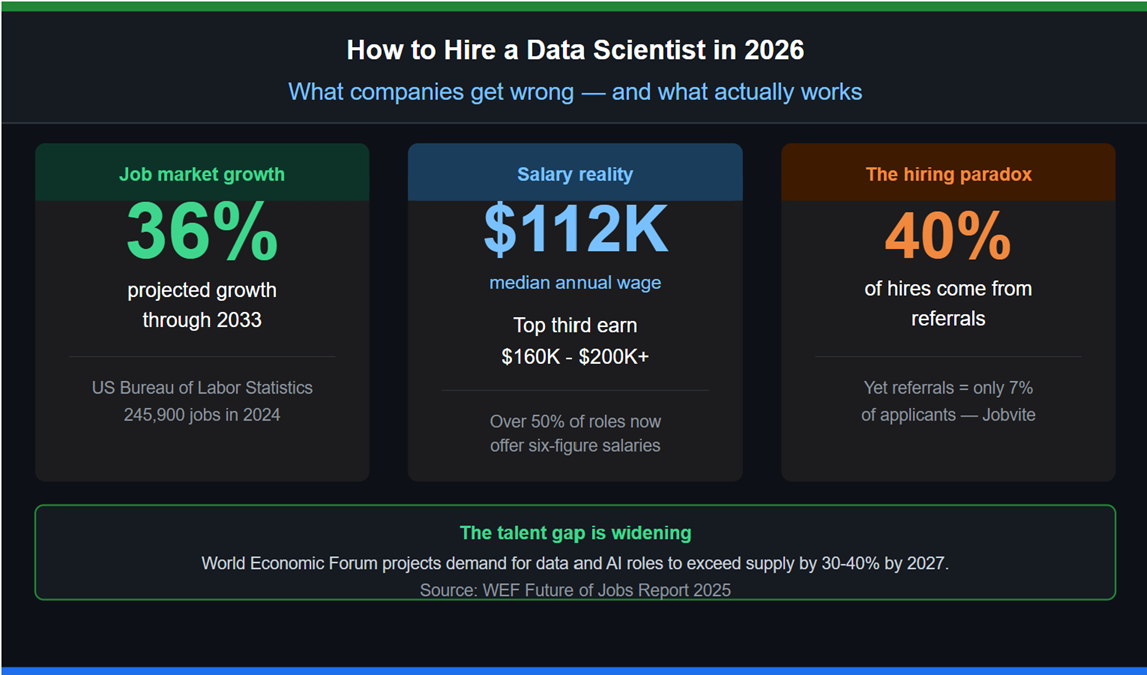
Data science roles are projected to grow 36% through 2033
according to the US Bureau of Labor Statistics. The World
Economic Forum projects demand for data and AI roles will
exceed supply by 30 to 40 percent by 2027. Over half of
data science jobs now offer six-figure salaries.
And yet hiring managers are struggling to fill these roles.
Candidates are sending out 400 applications and hearing
nothing back. Something is broken — and it is not the
talent pool.
The problem is almost always on the hiring side.
THE THREE MISTAKES COMPANIES MAKE
Mistake 1 — Writing the wrong job description.
The most common error we see is a job description that
describes a data scientist when the company actually needs
a strong analyst. As one practitioner with a decade in
the field put it bluntly: most companies do not need a
data scientist. They need someone who can write SQL,
build dashboards, and tell a coherent story with data.
Those are two very different profiles with very different
compensation expectations and very different interview
processes. Confusing them wastes everyone's time and
produces a hire that either leaves within a year because
they're bored or underperforms because they were hired
for depth they don't need.
Before writing a single line of the job description ask
this question: do we need someone to build and deploy
machine learning models or do we need someone to surface
business insights from our existing data? The answer
determines everything that follows.
Mistake 2 — Evaluating for skills that don't matter on the job.
Technical screening in data science hiring has gotten
out of hand. Candidates are being tested on AWS
architecture, Docker configurations, and obscure
algorithm implementations that rarely if ever come up
in real work.
Meanwhile the skills that actually determine whether
a data scientist succeeds — statistical reasoning,
business problem framing, model interpretability,
and the ability to communicate findings to non-technical
stakeholders — often get five minutes at the end of
a six-hour interview loop.
The practical test is simple. Look at what your last
data science hire spent their time on in their first
90 days. Were they deploying containers or were they
cleaning data, building dashboards, and explaining
their findings in business reviews? Screen for the
latter.
Mistake 3 — Moving too slowly.
The data science talent shortage is driving salaries
upward. As of 2025, over half of data science jobs offered
six-figure salaries, with about one-third paying between
$160,000 and $200,000 annually. These are not candidates
who are waiting by the phone.
The best data scientists — the ones with proven business
impact, clean portfolios and real deployment experience —
are fielding multiple conversations simultaneously. A
hiring process that drags past six to eight weeks is
not just slow. It is a candidate filter that
systematically eliminates the best people and leaves
you choosing from whoever had the patience to wait.
WHAT ACTUALLY WORKS IN 2026
The companies that hire well in this market do a few
things differently.
They start with the business problem not the title.
Instead of "we need a senior data scientist" they
start with "we need to reduce customer churn by 15%
and we don't know which customers are at risk." That
specificity attracts candidates who can solve that
problem and filters out everyone else.
They look for proof of work not just credentials.
A 4.0 GPA from a top program is a signal. A GitHub
repository showing a gradient boosting model that
achieved 97.9% AUC on real healthcare data is a
proof point. The best data scientists at every career
stage have built things and can show them to you.
Look for the portfolio.
They move fast when they find the right candidate.
The referral stat tells the real story here. According
to Jobvite, employee referrals make up just 7 percent
of applicants but yield 40 percent of hires — because
referred candidates move through the process faster
with a human connection already established. If you
are relying entirely on cold job board applications
you are fishing in the hardest pond.
They understand the AI layer has changed the bar.
In 2021 a strong data scientist needed Python, SQL,
and machine learning fundamentals. In 2026 those are
table stakes. The new bar adds AI fluency — the
ability to prompt effectively, validate AI-generated
code, and know when a model is confidently wrong.
Candidates who have integrated these skills into their
workflow are running circles around those who haven't.
WHERE 4 STAFFING CORP COMES IN
We specialize in placing data science and analytics
talent at growing technology companies. We know the
difference between a candidate who can pass a
technical screen and one who can actually move the
needle on your business problem in the first 90 days.
And because the best data scientists are not refreshing
job boards, we find them where they are — in their
current roles, quietly open to the right opportunity.
No hire. No fee. Nothing to lose.
Free consultation:
4staffing.net/index.php/contact
Learn more about our Data Science and Analytics recruiting practice:
4staffing.net/index.php/our-specialties/82-data-science-analytics-recruiting
Sources:
- US Bureau of Labor Statistics Occupational Outlook 2024
- World Economic Forum Future of Jobs Report 2025
- Jobvite Recruiting Benchmark Report 2025
- Refonte Learning Data Science Trends 2026
- Bureau of Labor Statistics median wage data May 2024
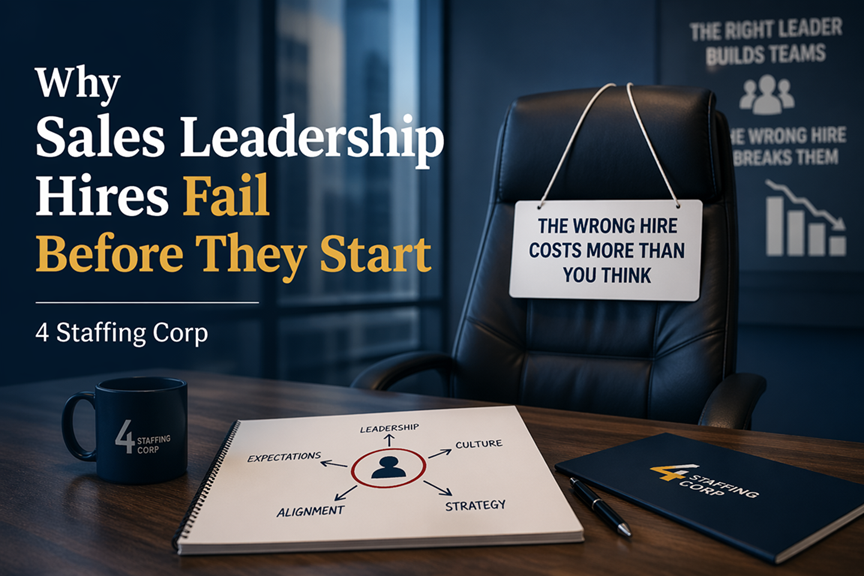
There is a position sitting open at your company right now...
Or there was one six months ago that you finally filled.
Or there will be one in the next 90 days that you don't
know about yet.
It is a sales leadership role. And the odds are not in
your favor.
THE NUMBERS ARE STARK
The average VP of Sales tenure is 18 months.
The average CRO tenure is just 25 months — the shortest
of any C-suite role. One in three CROs turns over every
single year.
The average time to fill a senior sales leadership role
in 2026 is ~68 days nationally. Most companies
allocate 30 days or fewer in their hiring plans.
Do the math. Your sales leadership seat is vacant for
twice as long as you planned. And when you finally fill
it the clock is already ticking on the next departure.
This is not a talent shortage problem.
It is a role design problem. And it is almost entirely
avoidable.
THE REAL REASON SALES LEADERS KEEP LEAVING
Ask most companies why their VP of Sales or CRO did not
work out and you will hear some version of the same story.
"They weren't the right culture fit."
"They couldn't scale with us."
"Their numbers weren't there."
What the data actually shows is something different.
The most common reason CROs leave within 18 months is
role ambiguity. They are hired with the title of Chief
Revenue Officer but scoped as a VP of Sales. They are
given a revenue target without authority over marketing,
customer success or revenue operations. They carry
accountability without control.
That is not a people failure. That is a structural failure.
The same pattern plays out one level down. VP of Sales
candidates are evaluated almost entirely on their revenue
history. Did they hit quota? How big was the team they
ran? What was their deal size?
What rarely gets evaluated is stage fit. A VP of Sales
who built a 40-person enterprise sales machine at a
mature public company is a completely different hire
than the person you need to build your first repeatable
sales motion from scratch at a 50-person startup.
Both can be exceptional at what they do. Neither can
do the other's job.
Putting the wrong stage-fit leader into your seat does
not just cost you the search fee. It costs you 18 months
of missed pipeline, a demoralized team and the time and
money to do the whole thing over again.
THE MARKET HAS ALSO GOTTEN HARDER
The external hiring environment for sales leadership
in 2026 has its own challenges layered on top of this.
Strong sales managers are simply not moving the way
they were in 2022. The job market that rewarded movement
and delivered 10 to 15 percent salary bumps for switching
has cooled. The leaders who stayed through 2024 and 2025
built internal stability and trust. That has real value
and they know it.
When your recruiter calls with an offer today the response
from a top sales manager is not automatic excitement.
It is evaluation. Predictability now beats incremental
upside for a significant portion of the best candidates
in the market.
This means the candidate pool you are fishing from is
narrower than it looks. Application volume stays high.
Quality candidates willing to make a move is a much
smaller number. And 82 percent of the best sales leaders
placed by specialized recruiters in 2025 were passive
candidates — people who were not actively looking and
had to be specifically identified and approached.
You are not going to find them on a job board.
WHAT ACTUALLY WORKS
Here is what the companies that get this right do
differently.
They define the role before they define the candidate.
Before writing a job description they answer three
questions: What specific problem does this leader need
to solve in the first 90 days? What authority and
resources will they actually have? And what does the
revenue motion look like today versus what it needs to
look like in 18 months?
The answers to those three questions tell you far more
about who you need than any list of requirements.
They hire for stage not for resume.
A leader with a track record of building zero-to-one
sales motions at growth-stage companies is a categorically
different hire than one who has optimized an existing
enterprise team. Both profiles are valuable. Neither is
interchangeable. Knowing which one you need, and being
honest about it, is the difference between an 18-month
departure and a five-year foundation.
They move faster than the market.
Senior sales candidates who are open to a move are
evaluating multiple opportunities simultaneously. The
companies that win them are not necessarily offering
the most money. They are offering the clearest vision,
the fastest process and the most credible leadership
team. A search that drags for 90 days does not just
cost you time... it costs you the specific candidates
who were ready to move in month one and took another
offer by month two.
They treat the search as strategic, not transactional.
High-quality sales leaders do not respond to generic
outreach. They respond to specific, personalized
conversations from people who understand their background
and can articulate exactly why this role is the right
next move for them specifically.
WHERE 4 STAFFING CORP COMES IN
We specialize in the search and placement of sales
leadership talent at growing technology companies —
VP of Sales, CRO, Sales Directors and the enterprise
account executives who execute their vision.
We focus exclusively on passive candidates. The leaders
worth hiring are not refreshing job boards. They are
running their teams and delivering results. Getting in
front of them requires a targeted, direct approach
built on real market knowledge.
And we work on contingency, which means no hire,
no fee. You carry no risk until we deliver.
If you have a sales leadership role open now — or
you can see one coming in the next quarter — this
is exactly the conversation we have every day.
Free consultation:
4staffing.net/index.php/contact
Learn more about our Sales Leadership recruiting:
4staffing.net/index.php/our-specialties/85-sales-leadership-recruiting
Sources:
- Prospeo CRO Guide 2026 (Pave dataset, 14,000 executives)
- eCare Recruiters Sales Manager Hiring Report 2026
- Corporate Navigators Time to Fill Benchmarks 2026
- Kapable Sales Leadership Statistics 2026
- Sales Talent Inc. 2025 Placement Data
More Articles …
4 Staffing Corp., Copyright © 2005-Present. All Rights Reserved. Privacy Policy